Austro-Hungary in the mid 19th Century
Austria as a power in Europe had acquired and dominated
the kingdom of Hungary since the 1600s and its possessions included the territory
that used to be known as Yugoslavia with Serbia under its control at a time. A
series of defeats in the hands of Napoleon Bonaparte had left the country
weakened after the Napoleonic wars.

Napoleon’s final defeat in 1815 gave Austria a breathing
space for stability and its leading states person Prince Klemens Von Metternich
came to play a dominant role in the proceedings of the Congress of Vienna that
was set up to resolve the issues of territories and restorations that arose
after the conclusion of the Napoleonic wars.
Austria’s lands and her influence over the Italian states
were restored. However, her claim on Belgium was forbidden. The setting up of
the German confederation also helped to fuel conflict between Austria and
Germany. Metternich suppressed all revolutionary tendencies until the
revolution of 1848 that began in France leading to the deposition of Louis
Napoleon II and spread into the Austrian controlled provinces of Bohemia,
Hungary and even Vienna.
The demand for constitutional reforms became so strong
that it led to the resignation of Metternich, after which he fled to England.
The revolts also spread to the Austrian controlled states in Italy, setting the
pace for the trend of events that would cause the Italian states to unite and
pave way for the emergence of the modern state of Italy.
The revolts were eventually put down by the Austrian army
in 1851. The effect of the revolts and agitations for unification of Germany
and Italy both under Austria’s control was to lead to weakness and decline in
the state of the empire. The agitation of the Italian states for unification
under the king of Sardinia led to the outbreak of war between Austria and
Sardinia in 1859.
Sardinia backed by Italian and French forces defeated
Austria in the ensuing war. This led to the loss of the Italian state of
Lombardy as well as decline of influence over the other Italian city states.
The same sequence of events was to repeat itself when the confederation of the
North German states eventually came to be.
The dispute led to
the seven days war in which Austria was defeated by a coalition of German and
Italian forces in 1866. This paved way for a new confederation of German states
without the involvement of Austria.
This turn of events emboldened the Hungarians to demand
for the privilege of equal status for the kingdom of Hungary and Austria. Under
a system of dual monarchy that union would produce the new nation of
Austro-Hungary between February to March 1867 when the Hungarian Parliament
confirmed the Ausgleich, the union of Austria and Hungary that had been
brokered by Emperor Francis 1 of Austria after Austria was expelled from the
confederation of German States following its defeat by Prussia in the Austro-
Prussian war of 1866.
This enabled both nations to exist under a common
monarchy while retaining autonomy in their respective domains and maintaining
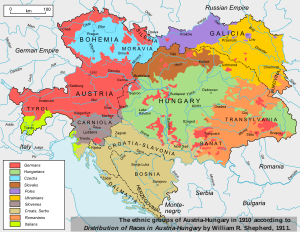
separate internal governments. This trend saw the Slavs and other minority
groups pressing for autonomy for their respective peoples and nations. The
Slavs in particular pressed for autonomy concerning the province of
Bosnia-Herzegovina which was a province just south of their border.
Several nationalistic and secessionist groups were thus
very active in Austro-Hungary at the turn of the century. The agitations and
dissensions were to be a major factor leading to the outbreak of World War I,
leading to the collapse of the Hapsburg monarchy and the disintegration of the
union of Austria and Hungary in the two decades following the beginning of the
20th century.
The events in Austro-Hungary had a major impact and
effect in shaping the future of Europe particularly with regards to agitations
for nationalistic and ethnic rights. The emergence of new nations and a pattern
of land and boundary adjustments laid an explosive mine on the path of peace in
Europe for half a century well into the 20th century.
THE SLAVE TRADE
AND EUROPE
Europe in 1850 was in the midst of the agitations for the
abolition of the Slave Trade. Even though most of the slaves were to be found
in North and South America, collectively referred to as the New World, the
nations that had the political and military might to end the transatlantic
trade were predominantly in Europe, primarily; Great Britain, France, Spain and
Portugal.
Although slavery in one guise or the other had flourished
in Europe for centuries, by the middle of the 19th century, most
legal forms of slavery had been abolished in mainland Europe except for a few
pockets in Eastern Europe stretching down to the Middle East.
However, England played a leading role in the struggle to
abolish slave trade. First was the issue of the repatriation of slaves from
England which was challenged and successfully stopped in a landmark ruling by
Chief Justice Granville Sharp who ruled in 1772 that James Somerset, a fugitive
slave from Virginia could not be forcibly returned to the Colonies by his
master.
The onus thus lay on Great Britain to lead the fight
against the slave trade globally. The movement was initially led by the Quakers
in England in 1783 when they presented the first important anti-slavery
petition to Parliament.
This was on the heels of the move by the Pennsylvania
Quakers who had voiced their opposition to slavery in 1688. In 1777 Vermont
became the first of the American colonies to outlaw slavery. Another
encouraging trend was the article incorporated into the United States
constitution which provided that slavery could be outlawed in 20 years
following the proclamation of the constitution.
Due to the effects of struggles of men like William
Wilberforce, the English Parliament passed a bill outlawing slavery in England
and all the colonies by 1807. Slavery was abolished in the British Caribbean
colonies on July 31, 1834 when 776,000 slaves who worked in the British
plantations were freed.
Encyclopedia
Britannica (2005; 293) “the British Imperial emancipation can be attributed to
the growing power of the philanthropic movement and a double switch of the British
Empire geographically from West (the Caribbean) to East (India) and
economically from protectionism to laissez-faire”.
In a parallel reaction, the British move in 1807 to
abolish slave trade impacted on the decision of the Juntas struggling for
Independence in Spanish America. The slave trade was abolished in Venezuela and
Mexico in 1810, in Chile in 1811 and in Argentina in 1812. In 1817, Spain
signed a treaty with Britain which provided for the abolition of the slave
trade in 1820; but the trade continued in the other Spanish colonies until
1880.
In America, a more tenuous struggle ensued in the effort
to abolish slave trade. While in most of the northern states, slavery had been
outlawed as early as 1804, it took a spiral of events from the soil movement to
the conflict over slave and non-slave owning states to the civil war,
emancipation by Abraham Lincoln in January 1 1863 to put a halt to slavery in
the south where the institution had been booming due to the cotton trade.
The final nail on
the coffin was the constitutional amendment of 1865 which formally put an end
to slavery in the United States of America. Puerto Rico put an end to slavery
in 1873 and Cuba followed suit in 1880.
Brazil was the
last nation in South America to abolish the trade and even this was made
possible only when the British government decided to station a squadron of the
Royal Navy in Brazilian waters with power to seize any vessels carrying slaves
engaging in the trade. Thus Brazil outlawed slave trade officially in 1888.
In Africa, the slave trade persisted into the 20th
century even when the continent was occupied militarily by the colonial
authorities because the colonial powers came to depend on local chiefs and
kings whose source of power lay primarily in a deluge of slaves left behind
after the official abolition of the Transatlantic trade.
Interestingly, slavery has persisted into the 21sth
century under more elaborate and benign schemes whereby human beings continue
to be trafficked as domestic servants, sex slaves or debt slaves. The practice
of slavery has in no small measure, continued to haunt the industrialized West
and to plague many Third World and African nations till date.
SPAIN IN THE MID
19TH CENTURY

1850 met Spain under the reign of Queen Isabella who
succeeded her father King Ferdinand who died on September 29, 1833. Isabella’s
reign was marked by a great crisis began by the Carlists war which started
almost as soon as she was enthroned queen.
The war was a conflict between urban liberalism and rural
traditionalism, between the poorly paid and equipped regular army of the
liberal governments, supporting Isabella and the semi-guerrilla forces of the
Carlists.
The period was also marked by a series of (progresista)
military uprisings. The Democratic Party was a leftist party that was prepared
to give the monarchy support if it gave them office. On the other hand, it was
ready to work for the dethronement of Isabella if she proved otherwise. By
1843, Isabella was officially declared of age to rule over Spain.
The democrats were more of an urban party, but very
radical nonetheless. Their ability to court orthodox (progresista) politicians
was curbed by their excesses even though they were also seen as an alternative
power base.
In any case, the revolt against Isabella eventually came
from a group of Generals led by Leopold O’Donnell whose grouse against the
dynasty lay in their perception of it as being too rigid and conservative and
thus cutting them off from influence.
The rebellion was however defeated mainly because Espartero
the leader of an alternative competing power base and an army officer proved
inept and incompetent in leading the revolt and was thus stopped because
O’Donnell broke ranks with the group to remain with the status quo.
In 1856 O’Donnell broke ranks with Espartero and helped
to suppress his supporters, and was also instrumental in dissolving the
national militia, the tool of the left wing progressives. In this way, the
radical movement was suppressed.

The period 1854-56 saw some economic expansion and
injection of capital from French Banks, which helped to finance a new national
railway network that was to help in modernizing the economy. The textile
industry in Catalonia also grew as methods of wool manufacture developed.
The Basque region also saw the expansion of another
segment of the economy, the iron and steel industries. Church and common lands
were made available for the commercial cultivation of wheat, and cities such as
Barcelona also expanded and created a market for vegetables, fruits and wines.
Spain prospered for a while as a new class of gentry and
property owners emerged from the economic expansion. All these flowered in the
rule of O’Donnell’s liberal union which was a coalition designed to fuse all
the shades of thought into one grand union.
The unwillingness of Isabella to merge the progressive and
democrats into one power base and instead sought to reign- in the influence of
the progressives gave impetus to a revolution led by O’Donnell’s supporters,
the military and an able general called Juan Prime whose military and political
skills helped to unseat Isabella and ensue her flight to France in September 1868.
The successful revolt led to a brief period of military
junta rule which was to be supported by a constitutional monarchy. The process
of that move and Primes’ attempt to proffer a Hohenzollern ruler as the
solution to Spain’s Royal succession issue was to lead to war between France
and Prussia in 1870.
However in November 1870, Amadeus second son of Victor
Emmanuel king of Italy was elected king while Prim, the king maker was
assassinated the day Amadeus entered into Madrid. Amadeus’ attempt to rule as a
constitutional monarch was met by opposition from both Republicans and Carlists
and he could form no stable government.
Once Amadeus called the Radicals to power, the
conservatives deserted the dynasty. Amadeus abdicated after an attack on the
army by the radicals in February 1873. The Cortes thereafter declared Spain a
Republic.
The Republic of 1873 came into existence to fill the
vacuum created by Amadeus’ abdication. The party was neither strong nor united,
and when the Republican leaders refused to proclaim a Federal republic, the
provincial leaders revolted.
The Canton-List revolt was serious. With the army seriously
depleted, the country seemed headed for disaster. The attempt of the Canton-lists
to lead the upheaval strengthened the Carlists immensely.
An attempt to put pressure on the Republic by General
Manuel Pavia Rodriguez de Albuquerque resulted in the Republican deputies being
driven from the Cortes building with a view to creating a government of order.
General Pavia handed over to General Francisco Serrano in order for him to form
a coalition government.
His attempt to suppress the Carlists, now a strong force
in Northern Spain failed, and on December 29 1874, a young Brigadier Arsenio
Martinez Campos imposed Alfonso XII the son of Isabella on the throne.

The restored monarchy flourished for a while, allowing
peace to reign. Spain enjoyed universal suffrage and continued to modernize.
The country at this time began to experience challenges over her Colonial
policies particularly with regards to Cuba, Puerto Rico and Hawaii in a protracted
conflict with the United States government.
The battles to suppress the revolts in her overseas
colonies sapped the nation, in spite of the enormous spending and sacrifices of
its men. The ensuing conflict with the United States popularly known as the
Spanish/American war, led to Spain’s defeat and loss of all her overseas
colonies including a great naval defeat that left the nation greatly demoralized.
The late 1880s however were also a period in which
agriculture, industry and the wool industry flourished. Industrial growth, investment
in iron and steel surged and generally the standard of living improved. Spain
developed the third largest wool industry in Europe and the general economic
growth did not abate until a depression set in, in the late 1880s.

No comments:
Post a Comment